Your async agent memory is answering from the past
Preprint: Read-After-Write Staleness and History Erasure in Asynchronous LLM Agent Memory (opens in a new tab) (Zenodo, doi:10.5281/zenodo.24446418). Code and every number below: github.com/jagritvats/deltawal (opens in a new tab).
The bug
Most LLM agent memories work the same way. After each conversation session, an LLM extracts facts ("user lives in Austin"), embeds them, and stores them. At question time you retrieve the most similar facts and hand them to the reader model.
Extraction is slow, so it moves off the write path: the client gets an acknowledgement right away, the session goes onto a message broker, and a worker extracts it later. That is a sensible design, and it has a read-after-write hole. If the user says "I moved to Denver" and then asks "where should I get dinner tonight?" before the worker has committed that session, the reader sees only "Austin". It answers confidently and wrongly, and nothing looks broken: no error, no empty retrieval, just a superseded fact.
There is a second, quieter failure. Once the update does commit, a store that updates facts in place, or a read path that hides older facts once a newer one exists, loses the earlier value. "Where did I live before Denver?" now has no answer. I call these read-after-write staleness and history erasure.
How I measured it
I used 138 held-out LongMemEval-S questions, including 60 knowledge-update (KU) and 52 temporal-reasoning questions. A deterministic lag barrier holds back the last ℓ sessions' extraction when the question arrives, so the update is still in flight. I tested three readers: gemma4 (12B, local), glm-5.3 and gpt-6-luna.
What fails
- Plain async (B2) answers 10.0–11.7% of KU questions correctly with one session in flight, against 76.7–83.3% for the synchronous store (B1). Most of those errors are stale reads: 53.3–68.3% of KU answers give the old value. A stronger reader doesn't help, because the right fact isn't in its context.
- A recency window (B3), which appends the newest uncommitted raw turns to the prompt, recovers part of the loss (63.3–80.0% KU) but still gives stale answers on 11.7–30.0% of KU questions.
What works: DeltaWAL
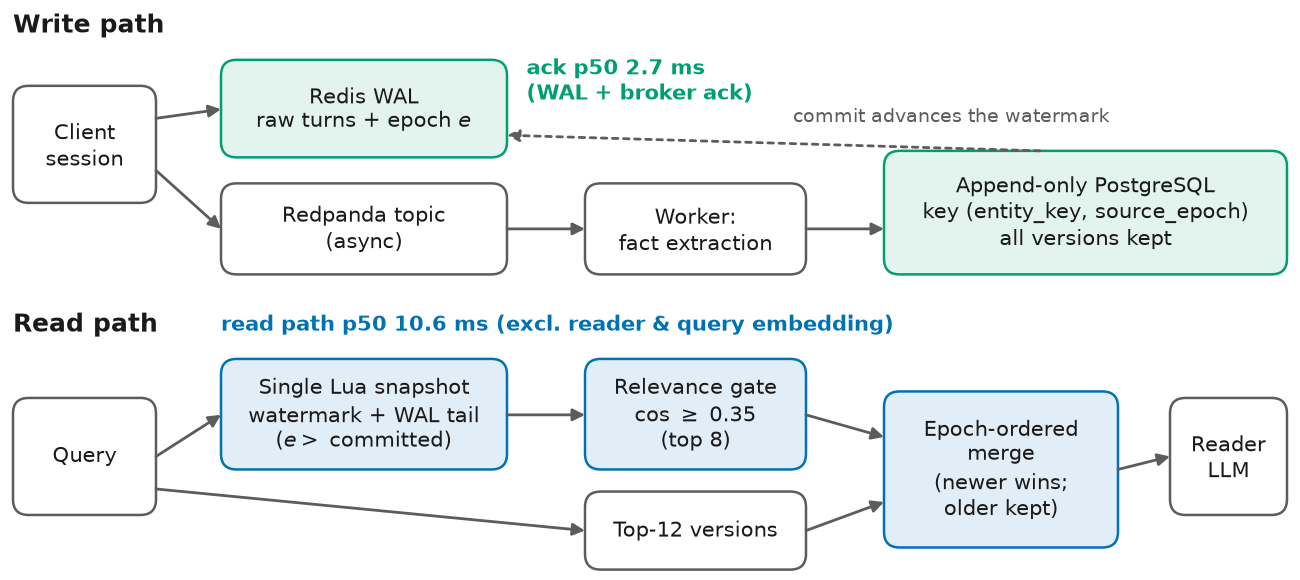
The fix is a write-ahead log. Before publishing a session to the broker, I append its raw turns to a Redis WAL with a monotonic per-user epoch. That's one atomic Lua script, so the client is acknowledged as soon as the turns are in the log. At read time:
- Take the WAL tail that hasn't been committed to the fact store yet.
- Gate it by relevance. Keep only tail turns whose cosine similarity to the question is at least 0.35.
- Merge the surviving turns with retrieved facts, in epoch order, with epoch tags.
DeltaWAL-Versioned also keeps every version of a fact instead of overwriting it.
At lag 1, DeltaWAL-Versioned answers 88.3–96.7% of KU questions correctly. With glm-5.3 it scores 96.7%, exactly its score with a complete store.
The gate does the work. This was the ablation I cared most about. If you fill the same tail budget with the newest uncommitted turns instead of the relevance-gated ones, accuracy drops from 84.5% to 39.1% pooled over readers (193 questions lost, 5 won; p < 0.001). The evidence usually sits earlier in the in-flight session, not in its last few turns.
The explicit "newer wins" instruction in the prompt adds nothing measurable: removing it gives 83.8% against 84.5% (p = 0.580). Ordering and dates carry the precedence; you don't need to tell the model.
Latency. All DeltaWAL variants share one write path. The write acknowledgement is 2.67 ms at the median with in-memory Redis, against 10,168 ms for synchronous extraction with a local 12B model. With appendfsync always it was 18.3 ms, in a back-to-back run where in-memory measured 7.27 ms on the same loaded machine. The read path, excluding the reader and query embedding, is 10.6 ms at the median.
History erasure, including in Mem0
At lag 0, where staleness plays no role, an in-place store answers 43.6% of past-value KU questions with a plain prompt and 46.2% with epoch tags. An append-only store with the same tagged prompt answers 97.4% (20 won, 0 lost, p = 0.016). So the gain comes from the store, not the prompt format.
Read-side masking does the same damage on an intact store. Dropping facts that a newer WAL sentence resembles takes past-value accuracy from 84.6% with masking off down to 15.4% at the most aggressive threshold, and buys nothing on current-value questions.
I then ran Mem0 OSS 1.0.11, a widely used open-source memory library, on the 60 KU questions. Its UPDATE path rewrites memories in place, and it updated the older evidence memory in place on 11 of the 13 past-value questions. Synchronous Mem0 answers 48.7% of past-value questions, pooled. The old text still exists, but only in a history table exposed by Memory.history(), not by search.
A read-only hook that adds each retrieved memory's earlier versions to the prompt, in epoch order, raises KU accuracy from 76.7% to 88.3–91.7% (25 questions won, 0 lost, p = 0.001). Past-value accuracy goes to 100.0%, with no current-value question lost. To be honest about the mechanism: in 5 of the 13 past-value questions the old value survived only in history; in the other 8 it was still live, and the hook helped by presenting versions in order.
Where it breaks
- Worst case by construction. Every question arrives while its update is in flight, so these staleness rates are conditional on that, not deployment rates. Your real exposure depends on how often questions land inside the extraction window.
- False corrections. Newer-wins ordering is the wrong rule when the later statement is false. On 17 clean static-conflict questions from the synthetic MemConflict set, DeltaWAL-Versioned believed the later, false statement on 86.3% against 64.7% for the synchronous baseline (11 answers flipped toward it, 0 away; p = 0.015, but 0.058 under a second judge). This is exploratory, but real.
- Small readers and raw turns. gemma4's temporal accuracy drops from 65.4% at lag 0 to 48.1% at lag 1, while glm-5.3 holds 86.5%. Prompt length isn't the cause: padding a lag-0 prompt to the lag-1 length keeps 67.3%. The 12B model misreads "today" in raw turns. Dating the tail turns or putting them before the facts each recovers about half of the gap (57.7%).
If you run async memory, do this
- Log before you publish. Append raw turns with a monotonic epoch to a WAL in the same step as the acknowledgement.
- Read the uncommitted tail, gated by relevance, not by recency.
- Merge in epoch order, with dates. Skip the "newer wins" instruction.
- Never overwrite or mask facts. Keep versions; if your store already overwrites (Mem0's UPDATE), surface
history()at read time. - Pick your durability deliberately.
appendfsync alwayscosts about 11 ms per write here. - Decide how to handle false corrections, and test temporal questions with your smallest reader.
Code, harness and every number in this post are in the repo (opens in a new tab). Every figure traces back to paper/numbers_manifest.json.